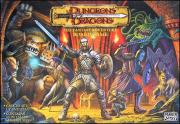
Dungeons & Dragons

There is a peculiar moment, repeated in basements and rec rooms across America from 1974 onward, when a teenager, having just decided that her magic-user wants to gracefully leap from a chandelier onto a goblin's head, announces this to the table, and is met instead by a Dungeon Master who looks down at the three small staple-bound booklets in the woodgrain box and realizes there are no rules for this. None. There is no acrobatics check. There is no skill list. There is nothing at all to consult except, somewhere in the back of his head, his own sense of what is fair, what is fun, and what he can get away with.
So he makes up a number. The chandelier is leapt from, or isn't, on the basis of his private cosmology.
This is supposed to be the great game of imagination, and in this particular moment, it briefly is.
What Gary Gygax in Lake Geneva and Dave Arneson in St. Paul actually produced, through years of mailed letters and intermingled play groups, was a strange hybrid: a game that took its bones from tactical wargaming — hexes, combat tables, morale checks, treasure-by-monster-type — and grafted onto them a kind of unstructured improvisational space the rules themselves could not contain. The three booklets in the original box (Men & Magic, Monsters & Treasure, The Underworld & Wilderness Adventures) are, in places, dense with charts. There are matrices for hit probabilities. There are tables for what a dragon is sitting on. There are procedures for stocking dungeon rooms by random roll. But what the booklets do not contain — and this is the more revealing fact — is any system for adjudicating most of what a player might actually want to do.
This is the great original tension of the game, and it has very little to do with imagination versus bureaucracy in any simple sense. The 1974 rules bureaucratize a very specific slice of experience: violence and accumulation. They have a great deal to say about how to hit something with a sword and how much gold the body might be carrying. They have nothing to say about whether the body had a family. They have a treasure table; they do not have a grief table. This is not because their authors were callous. It is because they inherited a wargaming tradition that knew how to measure exactly two things — damage inflicted, ground gained — and assumed everything else was either obvious or, more usefully, the Dungeon Master's problem.
And so the Dungeon Master became something stranger than an adjudicator. He became the entire missing apparatus. Every social interaction with a non-player character, every clever use of an item, every attempt to do something the booklets had not anticipated — and the booklets had anticipated almost nothing outside of combat and looting — required his sovereign ruling. The rules were not, in 1974, the kind of comprehensive code they would become by 1978 with Advanced Dungeons & Dragons, or by 2000 with the unified d20 skill system. They were a small administrative state in a vast wilderness of improvisation, and the DM was the only functioning office in town. Every table reenacted, in miniature, the political theology of any system in which sparse codes meet absolute discretion. The rules existed. The rules were sacred where they applied. And everywhere else, the DM said so.
Look at what a 1974 character sheet — which players had to draft on blank notebook paper, the box not having bothered to include one — actually recorded. Six ability scores. Hit points. Armor class. Alignment. A class (Fighting Man, Magic-User, or Cleric, in the original three; the Thief would arrive in the following year's Greyhawk supplement). A list of equipment, valued in gold pieces. That is essentially the self. The character is a small ledger of attributes, a personnel file with edges. Hit Points, in particular, is one of the quiet masterpieces of bureaucratic abstraction — your continued existence as a numerical quantity that depletes. Not a wound. Not a story. A number. Death is what happens when the number reaches zero. Few accounting innovations have so efficiently captured what it feels like to live inside a culture that measures everything.
The alignment system, meanwhile, was at this point only three-pointed: Law, Neutrality, Chaos. This is borrowed nearly without alteration from Michael Moorcock's Elric stories and Poul Anderson's Three Hearts and Three Lions, and it is worth pausing on, because what it describes is not ethics but cosmology. Law and Chaos are forces in the universe, not personality types. To be Lawful in 1974 was to be aligned with a metaphysical principle of cosmic order, the way one might be aligned with a deity or a season. The later move, in 1977, to graft a Good–Evil axis onto this and produce a tidy nine-box grid was the moment something genuinely interesting happened to American fantasy: a theology was reorganized into a personality test. A cosmic struggle became a multiple-choice question. That is the actual story of how managerial culture eats things — not by suppressing them, but by reformatting them into HR-compatible categories. The original three-point system, weirder and more pagan, was the casualty.
And yet — and this is where things get genuinely strange — people kept showing up. They still do. So clearly something other than the rules was doing the work.
Look at what an adventuring party actually is, sociologically. Three to six people, usually with no prior contractual relationship, pool their resources, share their rations and bedrolls, divide their treasure by mutually agreed-upon principles, accept that the cleric will heal the fighting man for free because the fighting man takes the hits, and collectively decide on courses of action through what is, more or less, consensus process punctuated by the occasional rolled die. There is no boss. There is no wage. The magic-user does not own the means of fireball production and rent them to the fighting man. They are, in the strictest possible sense, a small anarchist commune that has decided to fund itself by armed expropriation from the local feudal elite, who in this fiction happen to be lizards.
The genius of the original game, and the part its booklets could not articulate because they came from a wargaming world that had no vocabulary for it, is that the format produced a vivid working model of mutual aid and horizontal decision-making and then dressed it up in chainmail. Every Tuesday night, in suburban living rooms across the country, teenagers were rehearsing forms of cooperation their society told them were utopian and impossible. They were just doing it while pretending to be a Fighting Man named Grunk.
Of course, the cooperative inside of the party was funded by something considerably more grim outside of it. The dungeon, considered honestly, is a space — usually underground, usually old, usually populated by creatures coded as inhuman or pre-civilized — that "adventurers" enter in order to kill the inhabitants and take their stuff. The whole economy of the original game runs on this. The treasure tables in Monsters & Treasure are organized by monster type. The amount of gold a kobold owns is, in the game's bookkeeping, a property of being a kobold, the way a tax bracket is a property of being a middle manager. Gold flows upward from the goblins and ogres and dragons who, whatever their cosmological alignment, are not actually doing anything to the adventurers until the adventurers kick down their door. The dungeon, in other words, is a fantasy colony. The adventuring party is a small armed company. The campaign world is an extraction economy with extra elves.
This is why the genre's persistent flirtation with the word "savage" was never accidental. The dungeon imports the entire moral logic of the frontier: there is wealth out there, lying in the hands of people who don't quite count as people, and bringing it back is not theft but heroism — indeed, it is the very mechanism by which one becomes a higher-level person. Experience levels are, on inspection, the rate at which violence converts into status. Hit things. Take things. Become more. It is the whole history of primitive accumulation rendered as a leisure activity for math-club kids.
None of this means the game is bad, or that the people playing it are dupes. The opposite. The fact that it has survived and mutated for half a century — that people keep showing up, increasingly to ignore or rewrite its rules, to play sessions where nobody rolls a single die, to use it as group therapy or queer worldbuilding or improv theater with skeletons — suggests that what players were actually after was never the bureaucracy of combat and treasure. They were after each other. They were after the small commune at the table. The booklets were the price of admission, the alibi that let a generation of Americans sit in a circle and collectively imagine a different world without quite admitting that was what they were doing.
1974 was a good year to need an alibi. The war was ending in disgrace, the president had just resigned, the postwar dream of endless growth was meeting the oil embargo and the early grinding gears of what would soon be called neoliberalism. The American imagination was being told, with increasing firmness, that there were no more frontiers, no more alternatives, no more outside. And so a wargamer in Wisconsin and a wargamer in Minnesota, working out a hybrid through the mail, handed the country a basement, a torch, and a fistful of polyhedrons, and said: there is still somewhere to go. It just happens to be down.
The wonder is not that they bureaucratized combat and treasure. The wonder is that, even with all those tables and modifiers and stat blocks pulling toward the logic of the ledger, the thing that actually carried the game forward was the part the booklets could not write down. People at a table, making a world together, deciding by rough consensus what is real and what counts as a hit. Take away the dungeon, take away the dragons, take away even the dice, and what you have left is the oldest political technology humans possess. We have just gotten very strange about admitting it.
So he makes up a number. The chandelier is leapt from, or isn't, on the basis of his private cosmology.
This is supposed to be the great game of imagination, and in this particular moment, it briefly is.
What Gary Gygax in Lake Geneva and Dave Arneson in St. Paul actually produced, through years of mailed letters and intermingled play groups, was a strange hybrid: a game that took its bones from tactical wargaming — hexes, combat tables, morale checks, treasure-by-monster-type — and grafted onto them a kind of unstructured improvisational space the rules themselves could not contain. The three booklets in the original box (Men & Magic, Monsters & Treasure, The Underworld & Wilderness Adventures) are, in places, dense with charts. There are matrices for hit probabilities. There are tables for what a dragon is sitting on. There are procedures for stocking dungeon rooms by random roll. But what the booklets do not contain — and this is the more revealing fact — is any system for adjudicating most of what a player might actually want to do.
This is the great original tension of the game, and it has very little to do with imagination versus bureaucracy in any simple sense. The 1974 rules bureaucratize a very specific slice of experience: violence and accumulation. They have a great deal to say about how to hit something with a sword and how much gold the body might be carrying. They have nothing to say about whether the body had a family. They have a treasure table; they do not have a grief table. This is not because their authors were callous. It is because they inherited a wargaming tradition that knew how to measure exactly two things — damage inflicted, ground gained — and assumed everything else was either obvious or, more usefully, the Dungeon Master's problem.
And so the Dungeon Master became something stranger than an adjudicator. He became the entire missing apparatus. Every social interaction with a non-player character, every clever use of an item, every attempt to do something the booklets had not anticipated — and the booklets had anticipated almost nothing outside of combat and looting — required his sovereign ruling. The rules were not, in 1974, the kind of comprehensive code they would become by 1978 with Advanced Dungeons & Dragons, or by 2000 with the unified d20 skill system. They were a small administrative state in a vast wilderness of improvisation, and the DM was the only functioning office in town. Every table reenacted, in miniature, the political theology of any system in which sparse codes meet absolute discretion. The rules existed. The rules were sacred where they applied. And everywhere else, the DM said so.
Look at what a 1974 character sheet — which players had to draft on blank notebook paper, the box not having bothered to include one — actually recorded. Six ability scores. Hit points. Armor class. Alignment. A class (Fighting Man, Magic-User, or Cleric, in the original three; the Thief would arrive in the following year's Greyhawk supplement). A list of equipment, valued in gold pieces. That is essentially the self. The character is a small ledger of attributes, a personnel file with edges. Hit Points, in particular, is one of the quiet masterpieces of bureaucratic abstraction — your continued existence as a numerical quantity that depletes. Not a wound. Not a story. A number. Death is what happens when the number reaches zero. Few accounting innovations have so efficiently captured what it feels like to live inside a culture that measures everything.
The alignment system, meanwhile, was at this point only three-pointed: Law, Neutrality, Chaos. This is borrowed nearly without alteration from Michael Moorcock's Elric stories and Poul Anderson's Three Hearts and Three Lions, and it is worth pausing on, because what it describes is not ethics but cosmology. Law and Chaos are forces in the universe, not personality types. To be Lawful in 1974 was to be aligned with a metaphysical principle of cosmic order, the way one might be aligned with a deity or a season. The later move, in 1977, to graft a Good–Evil axis onto this and produce a tidy nine-box grid was the moment something genuinely interesting happened to American fantasy: a theology was reorganized into a personality test. A cosmic struggle became a multiple-choice question. That is the actual story of how managerial culture eats things — not by suppressing them, but by reformatting them into HR-compatible categories. The original three-point system, weirder and more pagan, was the casualty.
And yet — and this is where things get genuinely strange — people kept showing up. They still do. So clearly something other than the rules was doing the work.
Look at what an adventuring party actually is, sociologically. Three to six people, usually with no prior contractual relationship, pool their resources, share their rations and bedrolls, divide their treasure by mutually agreed-upon principles, accept that the cleric will heal the fighting man for free because the fighting man takes the hits, and collectively decide on courses of action through what is, more or less, consensus process punctuated by the occasional rolled die. There is no boss. There is no wage. The magic-user does not own the means of fireball production and rent them to the fighting man. They are, in the strictest possible sense, a small anarchist commune that has decided to fund itself by armed expropriation from the local feudal elite, who in this fiction happen to be lizards.
The genius of the original game, and the part its booklets could not articulate because they came from a wargaming world that had no vocabulary for it, is that the format produced a vivid working model of mutual aid and horizontal decision-making and then dressed it up in chainmail. Every Tuesday night, in suburban living rooms across the country, teenagers were rehearsing forms of cooperation their society told them were utopian and impossible. They were just doing it while pretending to be a Fighting Man named Grunk.
Of course, the cooperative inside of the party was funded by something considerably more grim outside of it. The dungeon, considered honestly, is a space — usually underground, usually old, usually populated by creatures coded as inhuman or pre-civilized — that "adventurers" enter in order to kill the inhabitants and take their stuff. The whole economy of the original game runs on this. The treasure tables in Monsters & Treasure are organized by monster type. The amount of gold a kobold owns is, in the game's bookkeeping, a property of being a kobold, the way a tax bracket is a property of being a middle manager. Gold flows upward from the goblins and ogres and dragons who, whatever their cosmological alignment, are not actually doing anything to the adventurers until the adventurers kick down their door. The dungeon, in other words, is a fantasy colony. The adventuring party is a small armed company. The campaign world is an extraction economy with extra elves.
This is why the genre's persistent flirtation with the word "savage" was never accidental. The dungeon imports the entire moral logic of the frontier: there is wealth out there, lying in the hands of people who don't quite count as people, and bringing it back is not theft but heroism — indeed, it is the very mechanism by which one becomes a higher-level person. Experience levels are, on inspection, the rate at which violence converts into status. Hit things. Take things. Become more. It is the whole history of primitive accumulation rendered as a leisure activity for math-club kids.
None of this means the game is bad, or that the people playing it are dupes. The opposite. The fact that it has survived and mutated for half a century — that people keep showing up, increasingly to ignore or rewrite its rules, to play sessions where nobody rolls a single die, to use it as group therapy or queer worldbuilding or improv theater with skeletons — suggests that what players were actually after was never the bureaucracy of combat and treasure. They were after each other. They were after the small commune at the table. The booklets were the price of admission, the alibi that let a generation of Americans sit in a circle and collectively imagine a different world without quite admitting that was what they were doing.
1974 was a good year to need an alibi. The war was ending in disgrace, the president had just resigned, the postwar dream of endless growth was meeting the oil embargo and the early grinding gears of what would soon be called neoliberalism. The American imagination was being told, with increasing firmness, that there were no more frontiers, no more alternatives, no more outside. And so a wargamer in Wisconsin and a wargamer in Minnesota, working out a hybrid through the mail, handed the country a basement, a torch, and a fistful of polyhedrons, and said: there is still somewhere to go. It just happens to be down.
The wonder is not that they bureaucratized combat and treasure. The wonder is that, even with all those tables and modifiers and stat blocks pulling toward the logic of the ledger, the thing that actually carried the game forward was the part the booklets could not write down. People at a table, making a world together, deciding by rough consensus what is real and what counts as a hit. Take away the dungeon, take away the dragons, take away even the dice, and what you have left is the oldest political technology humans possess. We have just gotten very strange about admitting it.
Mini Review: In 1974, D&D birthed a strange hybrid: a game of limitless imagination whose rules bureaucratized exactly two things—violence and accumulation. Everything else was abandoned to the absolute discretion of the Dungeon Master. Yet beneath this grim ledger of math, monsters, and gold lay a paradox. Players weren't merely escaping cynical '70s America. Hiding behind the guise of wargaming, they were secretly rehearsing a radical new way to live.