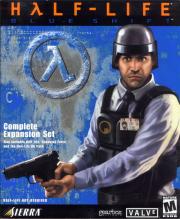
Half-Life: Blue Shift

Clock Out, Calhoun: Half-Life: Blue Shift and the Worker's-Eye Apocalypse
There is a peculiar honesty to Half-Life: Blue Shift, the 2001 expansion pack that almost nobody remembers and nobody at the time seemed to think was very important. Released as a budget tie-in, originally intended as filler for the Dreamcast port of Half-Life that Sierra quietly canceled in mid-2001 citing "changing market conditions" — a phrase that does a lot of bureaucratic work — it's a four-hour game in which you play Barney Calhoun, a Black Mesa security guard, as he tries to escape the same alien resonance cascade that turned theoretical physicist Gordon Freeman into a crowbar-wielding messiah. Freeman saves the world. Barney is just trying to make it to his car.
This is not, strictly speaking, a heroic premise. It is a working-class premise, and the difference matters more than the franchise has ever been willing to admit.
Consider what Barney actually does for a living. He's a rent-a-cop in a top-secret government research facility, which means his entire occupational existence is structured around two functions: opening doors for people more important than himself, and standing in hallways looking vaguely menacing in case anyone tries to enter who shouldn't. In the taxonomy of useless work that has become unavoidable in any honest discussion of late capitalism, Barney is what we might call a pure goon — someone whose job exists only because other people have jobs that require the existence of goons. His labor is structurally redundant; remove every security guard from Black Mesa and the science continues unimpeded until, you know, the dimensional rift opens. His presence is a status marker, a way for the institution to perform the seriousness of its own secrets.
And yet Blue Shift asks you to spend its entire runtime inhabiting precisely this position, and something strange happens when you do. The game becomes, almost despite itself, a study in what it feels like to occupy the lowest rung of a hierarchy you didn't design and don't understand. Barney spends the opening chapter riding the tram, watching the facility wake up. Scientists chat about classified projects he isn't cleared to know about. Doors hiss open for credentialed personnel and stay locked for him. When the disaster strikes, his first instinct isn't to investigate — it's to find a working elevator. The gameplay loop reduces, in essence, to a series of scientists asking Barney to do things for them: flip this switch, guard this door, escort me through this hazard. Even the apocalypse, it turns out, doesn't get you out of running errands for your superiors.
This is the deep weirdness of the Half-Life universe that Blue Shift, by accident, exposes. Black Mesa is a totalizing institution — a closed, hierarchical, government-funded research city in the New Mexico desert where everyone wears a color-coded uniform indicating their function and rank. The HEV suits, the lab coats, the security blues: the place runs on the same logic as a hospital or a military base or one of those medieval monastic orders that issued specialized footwear depending on whether you were allowed to read books. It is, in other words, an exemplary bureaucracy, and its catastrophe is a bureaucratic catastrophe. Nobody in Black Mesa actually understands what's happening, because no individual was ever supposed to. Knowledge is fragmented across departments precisely so that no one person, not even the administrator, can grasp the whole. The resonance cascade isn't just a science accident; it's the predictable result of a system designed so that responsibility cannot be located anywhere.
What's remarkable is that Barney, as a security guard, is forced to perform what we might call the duct-taping of this collapsing edifice. He fixes problems that exist only because someone else's grand abstraction failed. The scientists set off the cascade; Barney has to physically push through the ruins, flipping breakers, opening blast doors, hauling injured colleagues out of debris. There's a whole category of labor that consists entirely of patching the gap between how systems are supposed to work and how they actually work, and almost all of it is invisible until the system fails publicly. Blue Shift is a game about that labor. It is, structurally, four hours of the most thankless tier of crisis work — and the joke, if it is a joke, is that the game registers this as ordinary. Barney doesn't complain. He doesn't theorize his condition. He just keeps moving toward the exit.
The contrast with Gordon Freeman is where the whole thing becomes pointed. Freeman is the PhD from MIT, the theoretical physicist whose silent stoicism the franchise treats as a kind of secular sainthood. He is the credentialed hero, the man whose authority to save the world is implicitly ratified by his Ivy League pedigree. Barney has — what? Two years at someplace called Martinson College, undecided major, and a sidearm. The biographical detail is almost too on the nose: the person who started the credentialing process, didn't finish it, and ended up in a uniform in the New Mexico desert. The fact that Half-Life 2 would later promote him to resistance lieutenant feels, in retrospect, like a quiet admission that the franchise had been built on a slightly embarrassing premise: that of course the working stiff at the bottom of the org chart turns out to be more competent and more loyal than most of the scientists, because he had to be. He couldn't afford the luxury of theoretical detachment. He had to actually get the doors open.
There's a concept worth naming here: interpretive labor, the work of figuring out what people more powerful than you actually want, because they've never had to figure out what you want. Barney's job, even before the aliens, is interpretive labor in its purest form. He has to read the room of every scientist he encounters, intuit their needs, accommodate their priorities. The scientists, by contrast, treat him as essentially interchangeable scenery — a uniform with a flashlight. When the disaster hits, this asymmetry doesn't dissolve; it intensifies. Barney still does the reading; the scientists still issue the requests. The apocalypse is, for him, just an unusually demanding shift.
I don't want to oversell Blue Shift as some kind of accidental masterpiece of class consciousness. It isn't. It's a short, slightly janky expansion pack that was assembled under deadline pressure and was widely regarded, at release, as the runt of the Half-Life litter. But this is precisely what makes it interesting. Cultural artifacts are most revealing when they're not trying to be revealing — when they're just trying to ship on time and stay under budget. The official heroic mode of the Half-Life franchise wants you to identify with the silent genius. Blue Shift, almost despite itself, makes you identify with the guy whose entire professional existence consists of being condescended to by silent geniuses, and then asks you to escape a building that those geniuses have set on fire.
It's worth noting, finally, that Blue Shift wasn't made by Valve. It was made by Gearbox Software, the contractor brought in to produce budget expansion content on someone else's intellectual property — the studio doing the duct-taping, you might say, on the prestige franchise. Both Gearbox expansions — Blue Shift and Opposing Force— take the worker's-eye view; Valve's own games take the genius's. This is probably not a coincidence. The people hired to fill in the gaps in someone else's universe tend to notice, more readily than the universe's architects, that universes are mostly gaps, and that someone is always being paid not quite enough to fill them.
There's something close to a political theory hiding in this premise, though everyone involved would probably be horrified to be told so. It's the recognition that the people who actually keep complex institutions functioning are almost never the people those institutions celebrate, and that when things fall apart it's the goons and duct-tapers and interpretive laborers who do the work of survival, while the credentialed protagonists get the cinematics. Barney never gets a cinematic. He doesn't even get a sequel to himself. He gets four hours, a borrowed engine, a budget price point, a crowbar identical to Gordon's, and eventually a Black Mesa SUV idling in the desert with the other survivors, and the game ends when he drives away.
Which is, when you think about it, the only reasonable response to a workplace like Black Mesa. The fantasy of the heroic intervention belongs to the credentialed class. The fantasy of just clocking out and getting home alive belongs to everyone else. Blue Shift, almost alone among action games of its era, takes that second fantasy seriously, and that is why it deserves more than the footnote it's been given. It is a small game about the dignity of refusing to be a hero in someone else's catastrophe. We could use more of those.
Mini Review: Half-Life: Blue Shift is an accidental study in class consciousness. Instead of Gordon Freeman, an MIT physicist ordained to save the world, you play Barney, a Black Mesa rent-a-cop. Contracted to Gearbox Software, the game mirrors its own creation: working-class laborers duct-taping the failures of “geniuses.” As scientists trigger the apocalypse, your job is just fixing their mess. It offers a rare, radical fantasy: refusing heroic destiny and simply trying to survive your shift.