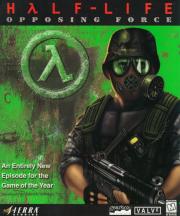
Half-Life: Opposing Force

This review contains spoilers
The Soldier Who Was Cleaned Up: Discipline, Secrecy, and the Carceral Logic of Half-Life: Opposing Force
There is a quiet cruelty at the heart of Half-Life: Opposing Force that the gaming press, in 1999, almost entirely missed. Gearbox's expansion to Valve's landmark first-person shooter was treated as a clever gimmick — same disaster, different uniform — when in fact it was something far stranger: a methodical inversion that reveals the original game's politics by walking through them backward. In Half-Life, you are Gordon Freeman, the credentialed scientist-victim, fleeing the apparatus that descended upon Black Mesa to scrub the experiment from the record. In Opposing Force, you are that apparatus. You are Corporal Adrian Shephard, HECU Marine, dropped into the same New Mexico hellscape with orders to liquidate the survivors. And then, by the end, you discover that the apparatus has its own apparatus, and you are not the hand that cleans but the smudge on the glass.
This is a game about how power eats its instruments. To understand why that matters, it helps to set aside the language of "good guys" and "bad guys" — the moralism that video game criticism still cannot quite shake — and look instead at the machinery by which bodies are made useful, made knowable, and finally made to disappear.
Consider Shephard himself. He arrives in the game already finished: trained at the Santego Military Base in a tutorial sequence that is, in its way, the most honest mission briefing in shooter history. You crawl through obstacle courses. You learn to handle the Desert Eagle, the M16, the sniper rifle. You strap into the PCV armor suit. You don the night-vision goggles. Drill instructors bark at you to hurry, to keep moving, to stop wasting their time — and yet the game never actually penalizes you for ignoring them. There is no clock, no score, no failure state for slowness. The discipline is purely vocal, ambient, atmospheric. This is, if anything, a more revealing portrait of how military training actually works than a stopwatch would be. Power here does not need to measure you; it only needs to surround you with the constant _implication_ of measurement, the felt presence of an evaluating gaze that may or may not be keeping records. You move faster because a voice is yelling, not because the voice can prove anything. The boot camp sequence is teaching the player to handle the controls, of course, but it is also doing something more candid than most shooters dare: it is showing the production of the soldier as a process of voluntary acceleration under unverified surveillance. By the time Shephard reaches Black Mesa, the drill instructor's voice has been internalized. He no longer needs to be yelled at. He moves at the speed the institution wants because he has learned to assume he is being watched.
This is why the game's combat feels so different from Freeman's. Freeman improvises. He picks up a crowbar because it is there. Shephard executes. He moves in coordinated squads, he uses radio chatter, he fits into a chain of command that exists whether or not he consents to it. When you order your engineer to cut through a locked door, or your medic to patch you up, you are not playing a lone hero — you are playing a node in a distributed system of expertise. Each Marine specialty (medic, engineer, grunt) is a little division of knowledge, a tiny dossier of skills the institution has arranged so that no single body has to know everything. This is bureaucracy as combat. It is also, not incidentally, how modern militaries actually function: not as collections of warriors but as distributed intelligences in which each person has been pruned to a specific competence.
And what is this competence for? Here the game becomes quietly devastating. Shephard's mission, like that of every HECU Marine, is to ensure that what happened at Black Mesa never officially happened. The Resonance Cascade is a problem of governance before it is a problem of biology. Aliens leak through dimensional rifts, yes, but the deeper threat is informational: scientists know things, security guards know things, janitors and cafeteria workers know things, and all of these knowings must be returned to silence. The Marines are not soldiers in the classical sense — they are not defending territory, they are not fighting another nation's army. They are an instrument of redaction. Their bullets are erasers. Black Mesa itself, with its restricted clearance levels, its sectors accessible only to specific badges, its underground tram system that ferries personnel through compartments they will never be allowed to enter, was already a space organized around the careful distribution of who-may-know-what. The disaster does not destroy this logic; it intensifies it. The facility becomes a kind of inverted prison — not one that holds inmates in, but one whose walls are dedicated to keeping its own truth from getting out.
In this light, Black Mesa belongs to that peculiar category of spaces that exist outside the ordinary social order while remaining indispensable to it: the secret laboratory, the black site, the research installation whose budget appears nowhere in any document a citizen could request. These are spaces where the rules of the surface world are suspended precisely so that the surface world can continue undisturbed. Opposing Force lets you walk through this kind of place not as its victim but as its sanitation crew, and the experience is genuinely uncanny. You are clearing rooms full of people whose only crime was showing up to work. The game does not editorialize. It does not need to. The act itself, repeated for hours, becomes the argument.
But here is the turn that elevates Opposing Force from a competent expansion into something genuinely worth thinking about. Midway through, a new enemy appears: the Black Operations units, or "Black Ops." They are faster than the Marines, better equipped, dressed in matte black with night-vision goggles. They are, you slowly realize, the cleanup crew sent to clean up the cleanup crew. The HECU's job was to silence Black Mesa; the Black Ops' job is to silence the HECU. Power does not stop at one layer of secrecy. It nests. Every instrument of erasure becomes, in turn, something that must itself be erased, because every instrument has seen too much. The soldier who killed the scientist must now be killed by someone with a higher clearance, who in turn — though the game does not show this — presumably has his own expiration date written into a folder somewhere in Virginia.
Shephard survives this nesting only because something stranger still has its eye on him. The G-Man, that pale figure in the cheap suit who haunts the Half-Life series like a bureaucrat from a dream, has been observing Shephard throughout, and at the game's conclusion he intervenes. He does not kill the Marine. He does something far more eloquent. He places him in stasis — suspended indefinitely, neither alive nor dead, neither punished nor pardoned, simply _withdrawn from circulation_. Shephard is filed away. He becomes an asset whose use has not yet been determined, stored against the possibility of later need.
This is the perfect carceral image, and it is worth lingering on. The classical prison punishes the body. The modern prison reforms the soul. But the G-Man's stasis chamber does something newer and more unsettling: it preserves a subject in pure potentiality, freezing him at the exact moment of his maximum usefulness, removing him from time so that he cannot age, cannot speak, cannot leak. Shephard is not silenced by death — death produces corpses, and corpses produce questions. He is silenced by suspension. The most efficient form of confinement, the game suggests, is not the cell but the indefinite hold. A body that exists nowhere cannot testify.
What Opposing Force finally offers, then, is a kind of x-ray of the original _Half-Life_'s political unconscious. The first game told you a story about a brilliant outsider who escapes the institution. The expansion tells you a story about the institution's own foot soldier, who discovers that he was never on the inside in any meaningful sense — that being useful to power and being protected by it are entirely different things. The Marine and the scientist, viewed from a sufficient height, are doing the same work: they are both producing material that the apparatus must then dispose of. Freeman is recruited at the end of Half-Life into the G-Man's employ. Shephard, having performed essentially the same actions with less prestige, is shelved.
This asymmetry is the most honest thing the game has to say about the cultures that produced it. The late-'90s American imagination was beginning to register, dimly, the shape of the security state that the following decade would make impossible to ignore. Opposing Force arrived two years before the War on Terror and the architecture of indefinite detention that came with it, and yet its closing image — a man held in suspension by a faceless authority that answers to no court and follows no schedule — reads now like a premonition. The game did not predict Guantánamo, of course. It simply noticed, with the clarity that genre fiction sometimes permits, that the logic was already in place. Somebody, somewhere, was already thinking about how to keep useful bodies in storage.
Played today, Half-Life: Opposing Force feels less like a curiosity and more like a thesis. It argues, through the medium of a corridor shooter, that the most interesting question about violence is not who pulls the trigger but who manages the silence afterward. It puts you inside the apparatus long enough to feel its weight, and then it shows you what the apparatus does to its own. It is a game about being used, and about discovering — too late, always too late — that the people who use you have already drafted the memo about what to do with you when you are no longer needed. The crowbar gets a sequel. The wrench gets shelved.
There is a quiet cruelty at the heart of Half-Life: Opposing Force that the gaming press, in 1999, almost entirely missed. Gearbox's expansion to Valve's landmark first-person shooter was treated as a clever gimmick — same disaster, different uniform — when in fact it was something far stranger: a methodical inversion that reveals the original game's politics by walking through them backward. In Half-Life, you are Gordon Freeman, the credentialed scientist-victim, fleeing the apparatus that descended upon Black Mesa to scrub the experiment from the record. In Opposing Force, you are that apparatus. You are Corporal Adrian Shephard, HECU Marine, dropped into the same New Mexico hellscape with orders to liquidate the survivors. And then, by the end, you discover that the apparatus has its own apparatus, and you are not the hand that cleans but the smudge on the glass.
This is a game about how power eats its instruments. To understand why that matters, it helps to set aside the language of "good guys" and "bad guys" — the moralism that video game criticism still cannot quite shake — and look instead at the machinery by which bodies are made useful, made knowable, and finally made to disappear.
Consider Shephard himself. He arrives in the game already finished: trained at the Santego Military Base in a tutorial sequence that is, in its way, the most honest mission briefing in shooter history. You crawl through obstacle courses. You learn to handle the Desert Eagle, the M16, the sniper rifle. You strap into the PCV armor suit. You don the night-vision goggles. Drill instructors bark at you to hurry, to keep moving, to stop wasting their time — and yet the game never actually penalizes you for ignoring them. There is no clock, no score, no failure state for slowness. The discipline is purely vocal, ambient, atmospheric. This is, if anything, a more revealing portrait of how military training actually works than a stopwatch would be. Power here does not need to measure you; it only needs to surround you with the constant _implication_ of measurement, the felt presence of an evaluating gaze that may or may not be keeping records. You move faster because a voice is yelling, not because the voice can prove anything. The boot camp sequence is teaching the player to handle the controls, of course, but it is also doing something more candid than most shooters dare: it is showing the production of the soldier as a process of voluntary acceleration under unverified surveillance. By the time Shephard reaches Black Mesa, the drill instructor's voice has been internalized. He no longer needs to be yelled at. He moves at the speed the institution wants because he has learned to assume he is being watched.
This is why the game's combat feels so different from Freeman's. Freeman improvises. He picks up a crowbar because it is there. Shephard executes. He moves in coordinated squads, he uses radio chatter, he fits into a chain of command that exists whether or not he consents to it. When you order your engineer to cut through a locked door, or your medic to patch you up, you are not playing a lone hero — you are playing a node in a distributed system of expertise. Each Marine specialty (medic, engineer, grunt) is a little division of knowledge, a tiny dossier of skills the institution has arranged so that no single body has to know everything. This is bureaucracy as combat. It is also, not incidentally, how modern militaries actually function: not as collections of warriors but as distributed intelligences in which each person has been pruned to a specific competence.
And what is this competence for? Here the game becomes quietly devastating. Shephard's mission, like that of every HECU Marine, is to ensure that what happened at Black Mesa never officially happened. The Resonance Cascade is a problem of governance before it is a problem of biology. Aliens leak through dimensional rifts, yes, but the deeper threat is informational: scientists know things, security guards know things, janitors and cafeteria workers know things, and all of these knowings must be returned to silence. The Marines are not soldiers in the classical sense — they are not defending territory, they are not fighting another nation's army. They are an instrument of redaction. Their bullets are erasers. Black Mesa itself, with its restricted clearance levels, its sectors accessible only to specific badges, its underground tram system that ferries personnel through compartments they will never be allowed to enter, was already a space organized around the careful distribution of who-may-know-what. The disaster does not destroy this logic; it intensifies it. The facility becomes a kind of inverted prison — not one that holds inmates in, but one whose walls are dedicated to keeping its own truth from getting out.
In this light, Black Mesa belongs to that peculiar category of spaces that exist outside the ordinary social order while remaining indispensable to it: the secret laboratory, the black site, the research installation whose budget appears nowhere in any document a citizen could request. These are spaces where the rules of the surface world are suspended precisely so that the surface world can continue undisturbed. Opposing Force lets you walk through this kind of place not as its victim but as its sanitation crew, and the experience is genuinely uncanny. You are clearing rooms full of people whose only crime was showing up to work. The game does not editorialize. It does not need to. The act itself, repeated for hours, becomes the argument.
But here is the turn that elevates Opposing Force from a competent expansion into something genuinely worth thinking about. Midway through, a new enemy appears: the Black Operations units, or "Black Ops." They are faster than the Marines, better equipped, dressed in matte black with night-vision goggles. They are, you slowly realize, the cleanup crew sent to clean up the cleanup crew. The HECU's job was to silence Black Mesa; the Black Ops' job is to silence the HECU. Power does not stop at one layer of secrecy. It nests. Every instrument of erasure becomes, in turn, something that must itself be erased, because every instrument has seen too much. The soldier who killed the scientist must now be killed by someone with a higher clearance, who in turn — though the game does not show this — presumably has his own expiration date written into a folder somewhere in Virginia.
Shephard survives this nesting only because something stranger still has its eye on him. The G-Man, that pale figure in the cheap suit who haunts the Half-Life series like a bureaucrat from a dream, has been observing Shephard throughout, and at the game's conclusion he intervenes. He does not kill the Marine. He does something far more eloquent. He places him in stasis — suspended indefinitely, neither alive nor dead, neither punished nor pardoned, simply _withdrawn from circulation_. Shephard is filed away. He becomes an asset whose use has not yet been determined, stored against the possibility of later need.
This is the perfect carceral image, and it is worth lingering on. The classical prison punishes the body. The modern prison reforms the soul. But the G-Man's stasis chamber does something newer and more unsettling: it preserves a subject in pure potentiality, freezing him at the exact moment of his maximum usefulness, removing him from time so that he cannot age, cannot speak, cannot leak. Shephard is not silenced by death — death produces corpses, and corpses produce questions. He is silenced by suspension. The most efficient form of confinement, the game suggests, is not the cell but the indefinite hold. A body that exists nowhere cannot testify.
What Opposing Force finally offers, then, is a kind of x-ray of the original _Half-Life_'s political unconscious. The first game told you a story about a brilliant outsider who escapes the institution. The expansion tells you a story about the institution's own foot soldier, who discovers that he was never on the inside in any meaningful sense — that being useful to power and being protected by it are entirely different things. The Marine and the scientist, viewed from a sufficient height, are doing the same work: they are both producing material that the apparatus must then dispose of. Freeman is recruited at the end of Half-Life into the G-Man's employ. Shephard, having performed essentially the same actions with less prestige, is shelved.
This asymmetry is the most honest thing the game has to say about the cultures that produced it. The late-'90s American imagination was beginning to register, dimly, the shape of the security state that the following decade would make impossible to ignore. Opposing Force arrived two years before the War on Terror and the architecture of indefinite detention that came with it, and yet its closing image — a man held in suspension by a faceless authority that answers to no court and follows no schedule — reads now like a premonition. The game did not predict Guantánamo, of course. It simply noticed, with the clarity that genre fiction sometimes permits, that the logic was already in place. Somebody, somewhere, was already thinking about how to keep useful bodies in storage.
Played today, Half-Life: Opposing Force feels less like a curiosity and more like a thesis. It argues, through the medium of a corridor shooter, that the most interesting question about violence is not who pulls the trigger but who manages the silence afterward. It puts you inside the apparatus long enough to feel its weight, and then it shows you what the apparatus does to its own. It is a game about being used, and about discovering — too late, always too late — that the people who use you have already drafted the memo about what to do with you when you are no longer needed. The crowbar gets a sequel. The wrench gets shelved.
Mini Review: Half-Life: Opposing Force is a masterpiece of quiet cruelty. Where the original game cast you as a victim fleeing institutional erasure, the expansion makes you the eraser. As a Marine in Black Mesa, your job isn't to save lives, but to redact them. Through atmospheric discipline and squad mechanics, the game turns you into a disposable node in a bureaucratic machine. It reveals a chilling truth: being useful to power and being protected by it are entirely different things.