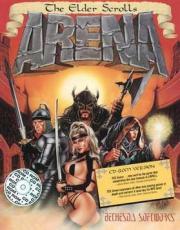
The Elder Scrolls: Arena

This review contains spoilers
The Emperor Who Wasn't There
Simulation, sovereignty and the endless road in The Elder Scrolls: Arena
A name with nothing behind it
The first thing to know about The Elder Scrolls: Arena is that its title refers to a game that was never made. Bethesda started out designing a gladiatorial combat game, with a team of fighters touring the arenas of a fantasy continent. Somewhere in development the arenas fell away and a sprawling first-person role-playing game grew in their place. The name stayed. To cover the gap, the game's backstory tells you that Tamriel is sometimes called "the Arena" because its provinces are always at war. The sign came first, and a meaning was made up afterward to justify keeping it.
That is a small piece of trivia, but it is also a good way into the game. Jean Baudrillard spent his career describing a culture where signs come loose from the things they once pointed to and keep circulating anyway. Eventually they produce a reality to match. Arena, released for MS-DOS in 1994, is an odd, rough, sometimes thrilling early case of that process in a medium that would come to embody it. It is a game about a counterfeit emperor ruling a generated empire. Its biggest ambition, a whole continent you could walk across without end, is also where it is weakest. The game is more interesting than it is good, though it is good more often than its reputation for punishing difficulty suggests. Its most revealing quality is how comfortable it is with emptiness.
The argument that follows is that Arena is a work of simulation in Baudrillard's strong sense. It does not represent a world. It generates one, and then, almost despite itself, it tells a story about how a generated world might be governed.
The map that comes before the land
Simulacra and Simulation opens with Borges's fable of imperial cartographers who draw a map so detailed that it covers the whole territory. Then the empire declines and the map rots in the desert. Baudrillard says the fable no longer fits us. Today the map comes first and produces the territory, and what is left of the real lies in scraps across a map that has spread over everything. He calls this "the precession of simulacra."
Arena does this literally. Most of its Tamriel was never designed by a person. Hundreds of towns, villages and dungeons are built by algorithm, and outside the city walls the wilderness is generated one patch at a time as you move. A patch exists only while you are standing in it. Pick a direction in the Hammerfell desert and keep walking, and the game will keep producing desert for as long as you are willing to hold down the key. It is the closest a 1994 game came to an infinite place, and it is genuinely awe-inspiring. Many years later, the feeling of setting off with no edge to the world in sight is still unsettling.
However, there is nothing out there. The wilderness has no landmarks, no history and nothing that rewards you for arriving anywhere in particular. The towns run together: the same blocky taverns, the same temples, and citizens with generated names who give the same handful of replies. Walking through Arena's world feels like reading a dictionary assembled by a random-word generator. Every entry is valid and none of them tells you anything. Baudrillard's line about information fits exactly: the more of it a system produces, the less meaning it carries, because the production uses up the meaning. Arena holds more Tamriel than any player could ever need, and the excess makes Tamriel thin.
This is the hyperreal in its most literal form. There is more world than there is any reason for. The surplus does not make the place feel deep. It makes the place feel like a procedure that happens to look like a continent. You never discover the generator's seed, but you sense it in every repeated wall texture. Arena's true geography is the code that writes its map, and its wilderness is the "desert of the real" with the metaphor taken out.
The emperor's other body
The plot is a two-line fairy tale, and it is far smarter than the rest of the writing. Jagar Tharn, the Imperial Battlemage, imprisons Emperor Uriel Septim VII in another dimension and uses illusion magic to take on his face. For ten years the empire is ruled by a copy. Nobody in the provinces revolts, and nobody notices.
Ernst Kantorowicz's The King's Two Bodies is the obvious reference, and it fits surprisingly well. Medieval and Tudor jurists, Kantorowicz showed, developed a theory that the monarch had two bodies. One was the body natural, which could get old, sick and die. The other was the body politic, which was undying and could not be wrong. It was the body politic that made the crown continuous: the king is dead, long live the king. Tharn's coup splits these two bodies apart as neatly as any thought experiment could. Uriel's body natural is stuck in a pocket of nowhere, and his body politic sits on the throne wearing a stolen face. What Kantorowicz treated as a mystical legal fiction, Arena turns into a practical matter. The body politic turns out to be portable. It goes wherever the right image is.
At this point Baudrillard asks for more than Kantorowicz can give. For the jurists, the body politic was a fiction holding something real together: a lineage, a realm, the continuity of law. Baudrillard separates dissimulating, which is pretending not to have what you have, from simulating, which is pretending to have what you don't. Dissimulation leaves the truth in place behind the mask. Simulation erodes the difference between true and false, because if the symptoms can be produced convincingly, nobody can say where the illness is. Tharn does not hide the real emperor so much as make him unnecessary. Taxes get collected, the legions march, and the provinces carry on. The scandal ofArena's backstory is not that the throne was usurped. It is that the usurpation changed nothing anyone could see. The empire was running on the image the whole time, and Tharn only removed the man the image was supposed to be attached to.
The game's moral imagery makes the point vivid in a way it seems not to fully grasp. The guide who leads you out of prison and visits you in dreams is Ria Silmane, Tharn's apprentice, whom he murdered. She is a ghost, a dead woman's image, and she is the only voice in the game you can trust. The emperor in the palace is alive, present and false. In Arena, an apparition speaks the truth while flesh and blood tells the lie.
The cell and the screen
Arena begins in a cell under the Imperial Palace, and the series has returned to that image ever since. Daggerfall's shipwreck aside, every major Elder Scrolls hero since has started out as a prisoner or a captive. This is where Michel Foucault comes in, and at first he seems to describe the game's machinery better than Baudrillard does. Before you take a step, the game examines you. You can choose a class, or you can answer a series of moral and situational questions, and the game sorts you into a type from your answers. Then it rolls your attributes and writes you up as a set of numbers. Discipline and Punish describes this exactly: the examination that makes each person a "case," documented, measurable and comparable, and the training that turns a body into something useful and obedient. The level-up, the experience bar and the dungeon that kills you until you learn its rhythms are a disciplinary curriculum. Arena's notorious opening dungeon, where an underpowered new character can die to the first rats and goblins, is a form of correction. The game is training you to be the kind of subject who can survive it.
In 1977 Baudrillard published Forget Foucault, an impatient polemic arguing that Foucault's elegant account of power was too perfect. It mirrored its subject so closely that it could only appear at the moment that kind of power was dying. In Baudrillard's view, power was no longer exercised by a gaze from a tower. It had become a simulation of itself, kept in circulation because nobody wanted to admit it was gone. Arena offers both readings at once, and the tension between them is the most interesting thing about it. Foucault reads the cell, the questionnaire and the stat sheet correctly. They really do discipline. But consider what happens once you escape. The prisoner climbs out of an enclosed space into a world with no walls, and no one is watching. The towns don't know you, the guards don't care, and the throne you are supposedly serving is occupied by an illusion. The disciplinary apparatus remains fully in place, while the sovereign it was meant to serve has vanished.
This is the Foucauldian prison turned into Baudrillard's screen. You are no longer kept in line by the possibility of being seen. You are kept in line by the interface itself: the compass, the automap, the next dungeon on the quest list. Discipline works without anyone exercising it. That is the condition Arena depicts in its own empire and also the condition it puts its player in.
Disneyland in the Imperial City
This makes the ending revealing. Over the course of the game you assemble the eight pieces of the Staff of Chaos from dungeons spread across the provinces. Then you return to the Imperial City, destroy Tharn and release Uriel Septim from his dimension. The real body goes back on the throne, the original is restored, and order resumes.
Baudrillard's most quoted passage describes Disneyland as an imaginary place presented as imaginary in order to make us believe that everything outside it is real. The theme park works as an alibi. Its obvious fakeness is what lets Los Angeles look authentic by comparison. Arena's main quest serves the same purpose for the game's world. By giving you a single, definite fake to defeat, it reassures you that a real emperor exists behind the false one and that the empire is something more than its image. The rest of the game argues quietly against that. If ten years of rule by a copy changed nothing, restoring the original also changes nothing. The final cutscene celebrates the return of the real, and the empire it hands back to you is still the same generated, endless and mostly empty road. Kantorowicz's jurists invented the body politic so the realm could outlast the death of its king. Arena suggests the realm can outlast its king's complete absence, which is a much stranger claim. The game reaches it more or less by accident, through the needs of its own technology.
That word, accident, sums up how I judge the game. Arena's philosophical interest and its artistic failings come from the same place, and it would be dishonest to call the failings intentional. The emptiness of its towns is not a critique of hyperreality. It is the emptiness of 1994 hardware and a small team trying to fill a continent. The main quest is a list of eight fetch errands, the combat is a clumsy business of swinging the mouse, and the writing seldom rises above functional. Even admirers concede that the first hours are a grind. Yet the vision is real and remarkable. Arena bet that a role-playing game could offer a world instead of a story, and that freedom of movement could be its own reward. It is a bet the whole open-world genre has been cashing in on since. Daggerfall made it bigger, Morrowind gave it meaning, and Skyrim turned it into a global habit.
What Arena has that its descendants smoothed away is an honesty about the deal. Later games pack their maps with authored detail so tightly that you can forget the map came first. Arena never hides it. Every identical village and every unbroken stretch of generated tundra reminds you that this world is a procedure wearing the costume of a place, ruled for a decade by a costume wearing the face of a king. It is not quite a great game. It is something rarer: a flawed work that shows the logic of a whole medium before that medium learned how to hide it.
Mini Review: A game about a fake emperor ruling a generated world. Its Tamriel is built by algorithm: endless wilderness, interchangeable towns, more land than meaning. Baudrillard would call it hyperreal, a map that comes before its territory. The plot fits. A battlemage wears the Emperor’s face, and the empire never notices, which suggests the crown lives in its image alone. Clumsy and often empty, Arena still lays bare the logic of the open world before later games learned to hide it.