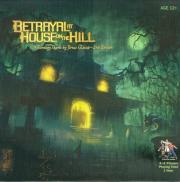
Betrayal at House on the Hill

We sit around the table, a collective consciousness navigating a cardboard void. We are seemingly united in our goal, engaging in the project of Betrayal at House on the Hill. At the outset, the game presents itself as a cooperative exercise in "Being-with-others." We reveal tiles, we construct the world room by room, and we laugh at the absurdity of finding a coal chute in the attic. In this phase, existence precedes essence; the house has no meaning until we, the players, impose our choices upon it. We are free, or so we tell ourselves, to explore the ground floor or ascend to the upper landing.
But this freedom is a terrifying vertigo. We are condemned to be free, and nowhere is this more apparent than in the accumulation of Omen cards. With every haunt roll, the anxiety mounts. We are not merely rolling plastic dice; we are interrogating the silence of the universe, waiting for it to scream back.
The brilliance—and the undeniable clumsiness—of this game lies in the inevitable rupture: The Haunt. Here, the comfortable illusion of solidarity is shattered. The dice fail us. The specific combination of Omen and Room dictates a new reality, forcing one among us to become the Traitor. This is the moment the game transcends its often-muddled mechanics to touch upon a profound truth: we are always one distinct circumstance away from becoming the villain in our neighbor’s story.
When the Haunt begins, the Traitor leaves the room to read their private tome. This separation is crucial. It is the physical manifestation of the radical gap between consciousnesses. When they return, the dynamic has shifted. I no longer see my friend across the table; I see the "Other." I feel The Look. Their gaze objectifies me; to them, I am no longer a subject with agency, but an obstacle—a bag of stats to be reduced to zero. Hell is not fire and brimstone; hell is the other players when the traitor’s tome gives them control over a zombie lord or a giant snake.
However, we must confront the game’s "facticity"—its material constraints. Betrayal is frequently a mess. The rules are often contradictory, the scenarios unbalanced, and the outcomes dictated by the uncaring chaos of RNG (random number generation). A modern designer might call this "bad design" or "broken." But from an existential view, this brokenness is the point. The universe is not balanced. The universe does not care if you have the Revolver or if you are stuck in the basement with no elevator. To complain about the unfairness of the Haunt is to operate in Bad Faith. It is an attempt to deny the reality of the situation: that we have been thrown into a scenario we did not choose, and we must act anyway.
The narrative emerges not from a tight script, but from the friction between our desire for order and the game’s inherent disorder. Sometimes, the story collapses. The traitor is overpowered instantly, or the heroes are trapped in a loop of futility. This is the absurdity of the human condition packaged in a box. We struggle, we roll, we argue over the interpretation of a vague card text, and in doing so, we define ourselves.
Ultimately, Betrayal at House on the Hill is a flawed masterpiece of social friction. It forces us to confront the fragility of our alliances and the terror of our own agency. We play, not because the mechanics are precise—they are often laughably loose—but because we crave the opportunity to define ourselves against the chaos. We enter the house together, but we leave alone, carrying the weight of the choices we made when the lights went out.
But this freedom is a terrifying vertigo. We are condemned to be free, and nowhere is this more apparent than in the accumulation of Omen cards. With every haunt roll, the anxiety mounts. We are not merely rolling plastic dice; we are interrogating the silence of the universe, waiting for it to scream back.
The brilliance—and the undeniable clumsiness—of this game lies in the inevitable rupture: The Haunt. Here, the comfortable illusion of solidarity is shattered. The dice fail us. The specific combination of Omen and Room dictates a new reality, forcing one among us to become the Traitor. This is the moment the game transcends its often-muddled mechanics to touch upon a profound truth: we are always one distinct circumstance away from becoming the villain in our neighbor’s story.
When the Haunt begins, the Traitor leaves the room to read their private tome. This separation is crucial. It is the physical manifestation of the radical gap between consciousnesses. When they return, the dynamic has shifted. I no longer see my friend across the table; I see the "Other." I feel The Look. Their gaze objectifies me; to them, I am no longer a subject with agency, but an obstacle—a bag of stats to be reduced to zero. Hell is not fire and brimstone; hell is the other players when the traitor’s tome gives them control over a zombie lord or a giant snake.
However, we must confront the game’s "facticity"—its material constraints. Betrayal is frequently a mess. The rules are often contradictory, the scenarios unbalanced, and the outcomes dictated by the uncaring chaos of RNG (random number generation). A modern designer might call this "bad design" or "broken." But from an existential view, this brokenness is the point. The universe is not balanced. The universe does not care if you have the Revolver or if you are stuck in the basement with no elevator. To complain about the unfairness of the Haunt is to operate in Bad Faith. It is an attempt to deny the reality of the situation: that we have been thrown into a scenario we did not choose, and we must act anyway.
The narrative emerges not from a tight script, but from the friction between our desire for order and the game’s inherent disorder. Sometimes, the story collapses. The traitor is overpowered instantly, or the heroes are trapped in a loop of futility. This is the absurdity of the human condition packaged in a box. We struggle, we roll, we argue over the interpretation of a vague card text, and in doing so, we define ourselves.
Ultimately, Betrayal at House on the Hill is a flawed masterpiece of social friction. It forces us to confront the fragility of our alliances and the terror of our own agency. We play, not because the mechanics are precise—they are often laughably loose—but because we crave the opportunity to define ourselves against the chaos. We enter the house together, but we leave alone, carrying the weight of the choices we made when the lights went out.
Mini Review: In the exploration phase, existence precedes essence; we construct the house and our fate. But the Haunt reveals the terror of freedom. The Traitor returns, and I feel The Look—I am no longer a friend, but an object to be destroyed. Hell is truly other players. The game’s mechanical "jankiness" is not a flaw, but a reflection of cosmic absurdity. To complain about unbalanced RNG is Bad Faith. We are condemned to roll, forcing meaning upon a chaotic, cardboard void.